
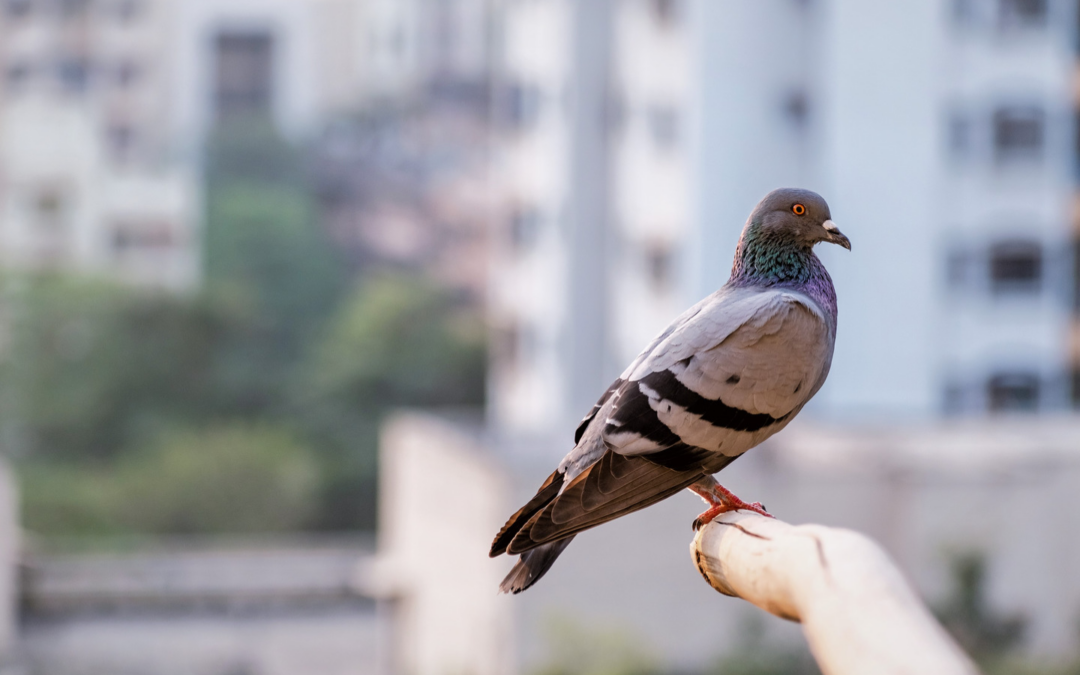
Quick answer: Pigeons stay on a commercial building when it gives them three things: food nearby, sheltered ledges to roost on and safe places to nest. Lasting pigeon control in Singapore means removing all three across the whole building. That involves cleaning up food sources, proofing the zones pigeons use with spikes, netting or wire, and monitoring the site afterwards. Treating one ledge at a time just moves the birds next door.
Key Takeaways
- Pigeons follow food. Bin centres, loading bays and outdoor dining areas draw them in. Proofing alone will not hold if food stays available.
- Treat the building, not the ledge. Pigeons move to the nearest untreated surface, so plan by zone across the whole property.
- Match the method to the behaviour. Spikes and wire stop perching. Netting stops nesting and entry into covered spaces.
- Clean before you proof. Droppings and old nests signal a safe site and weaken fixings.
- Expect pigeons to test new defences. Some pressure in the first weeks is normal. Monitoring catches gaps early.
- Responsibility is shared. Owners, MCSTs, facility managers and tenants each control part of the problem.
- Feeding is illegal. In Singapore, feeding wildlife can lead to fines of up to $10,000.
Who This Guide Is For
This guide is written for facility managers, MCST managers, building owners and operations teams responsible for offices, shopping centres, industrial buildings, food establishments, hotels, schools and mixed-use developments in Singapore. It explains why pigeons choose your building, where they concentrate, the six-step programme that keeps them away, which deterrents suit which zones, and what realistic results look like.
Why Are Pigeons Attracted to Commercial Buildings in Singapore?
Feral pigeons are city birds. Their wild ancestors nested on cliff ledges, and a modern building offers the same thing: high, sheltered ledges close to a reliable food supply. Singapore’s dense urban areas provide plenty of both.
Four factors draw pigeons to a commercial property:
- Food. Open bins, spilled refuse at loading bays, crumbs at outdoor seating and deliberate feeding by members of the public.
- Shelter. Recessed ledges, signage, beams, canopies and rooftop plant protect birds from rain and heat.
- Nesting sites. Covered voids, gaps under solar panels, ceiling spaces above loading bays and the tops of air-conditioning units.
- Site attachment. Pigeons return to roosting and nesting spots they have used before. Once a group settles on your building, it will keep coming back unless the site changes.
That last point explains why pigeon problems tend to get worse over time. A few birds roosting on a parapet become a flock, droppings build up, and the building becomes the established spot in the neighbourhood.
What Problems Do Pigeons Cause for Businesses?
Pigeons are more than an untidy nuisance. For many commercial premises, they create real operational costs.
- Hygiene risk. Droppings are associated with diseases such as histoplasmosis and psittacosis, especially where dried droppings are disturbed.
- Food safety and audits. Birds near ingredient storage, kitchens or loading bays raise concerns during food safety inspections and customer audits.
- Slips and liability. Droppings on walkways, steps and entrances become slippery in wet weather.
- Building damage. Acidic droppings stain and corrode façades, signage, metal fittings and roofing. Nests block gutters and drains, leading to water ponding.
- Equipment problems. Nests and droppings around rooftop plant, solar panels and ventilation equipment interfere with maintenance and performance.
- Image. Stained façades and birds over outdoor seating send the wrong message to customers and tenants.
| Premises Type | Main Pigeon Risk |
| Restaurants and food courts | Contamination of dining and food preparation areas |
| Food factories | Audit findings, product contamination risk |
| Offices and commercial buildings | Stained façades, slippery entrances, tenant complaints |
| Shopping centres | Outdoor dining, car parks and signage fouling |
| Warehouses and logistics | Droppings on stored goods and loading areas |
| Hotels | Guest complaints on balconies, pool decks and drop-off points |
| Schools and hospitals | Hygiene concerns in high-traffic and sensitive areas |
Where Do Pigeons Gather on Commercial Buildings?
Before choosing any deterrent, map where the birds actually go. Most commercial buildings have the same hotspots.
| Zone | What Pigeons Do There | Typical Solution |
| Roofline and parapets | Roost and watch for food | Spikes or post-and-wire |
| Façade ledges and sills | Perch and roost | Spikes, wire or bird slopes |
| Signage and lighting | Perch, foul signs below | Spikes or low-profile wire |
| Canopies and covered walkways | Roost and nest on beams | Netting under the canopy, spikes on beams |
| Loading bays | Feed and nest in the roof space | Netting of the overhead space, waste control |
| Multi-storey car parks | Roost on beams and pipes | Netting of affected bays, spikes on beams |
| Rooftop plant and solar panels | Nest in sheltered gaps | Mesh barriers and netting |
| Outdoor dining | Feed on scraps | Prompt table clearing, covered bins |
| Bin centres | Feed | Lidded bins, regular washing |
How Do You Keep Pigeons Away? A 6-Step Building Programme
A lasting result comes from a programme, not a single installation. This is the approach that works for most commercial premises in Singapore.
Step 1: Survey and map pigeon activity
Walk the building at different times, especially early morning and late afternoon, when pigeons are most active. Note where they perch, roost and nest, where droppings collect, and where they feed. Mark each location on a floor plan or roof plan. This map becomes the basis for every decision that follows.
Step 2: Remove food sources
This step is the one most often skipped, and it decides whether everything else lasts. Keep bins lidded and bin centres washed. Clear spilled refuse at loading bays. Clear outdoor tables promptly. Speak to tenants whose operations generate waste. If people are feeding birds around your premises, note it and report it. Feeding wildlife is prohibited in Singapore, and NParks states that offenders can face fines of up to $10,000.
Singapore agencies treat food-source removal as central to pigeon management. A pilot programme run by NParks, NEA, SFA and three town councils between July 2024 and March 2025 combined refuse management, action against illegal feeding, engagement with food establishments and population control. The Senior Minister of State for National Development reported that pigeon numbers in the pilot areas fell by around 50 per cent. Building owners cannot replicate the population control element, but they can control the food on their own premises.
Step 3: Clean and sanitise
Remove droppings, feathers and old nesting material before installing anything. Droppings act as a signal that a site is safe, and fixings attached to dirty surfaces fail sooner. Cleaning heavy accumulations should be done with protective equipment and proper disinfection, not dry sweeping. Professional commercial disinfection is the safer option for large deposits.
Step 4: Exclude and proof each zone
Choose the deterrent for each zone based on what the birds are doing there. Perching surfaces need spikes, wire or slopes. Nesting areas and covered spaces need netting. Our guide to bird spikes vs bird netting explains the difference in detail. Treat every zone pigeons use at once. Proofing one area while leaving the next untreated only shifts the problem.
Step 5: Monitor and adjust
Check the building regularly after installation. Look for birds testing the edges of netting, roosting on untreated ledges nearby or nesting in a spot that was missed. Adjust quickly. Small gaps found early are cheap to fix. Gaps found months later usually have a nest in them.
Step 6: Document everything
Keep records of surveys, installations, cleaning and follow-up inspections. Records matter for food businesses facing audits, for MCSTs reporting to councils and residents, and for facility managers who need to show what has been done. Our article on how often commercial pest inspections should be done covers inspection scheduling more broadly.
Need help mapping pigeon activity on your building? Precision Pest provides a complimentary site inspection for commercial premises. Our team maps how pigeons are using your property and recommends a zone-by-zone plan that combines proofing, cleaning and monitoring. Learn more about our commercial bird control programme.
Which Pigeon Deterrents Work Best on Commercial Buildings?
No single product solves every pigeon problem. Each method has a job it does well and situations where it falls short.
| Method | How It Works | Best Used For | Realistic Limits |
| Bird spikes | Blunt rods prevent landing | Narrow ledges, parapets, signage | Weak against nesting birds; debris must be cleared |
| Bird netting | Physically blocks access | Loading bays, canopies, car parks, rooftop plant | Must be tensioned and sealed at every edge |
| Post-and-wire | Tensioned wires make ledges unstable | Long parapets, ledges where spikes are too visible | Needs correct height and tension |
| Bird slopes | Angled panels remove the flat surface | Ledges and sills on visible façades | Suits specific ledge shapes |
| Repellent gels | Sticky, uncomfortable surface | Small areas, decorative or interior surfaces | Shorter lifespan, picks up dust |
| Visual deterrents | Reflective or moving objects scare birds | Supporting measure only | Pigeons get used to them quickly |
| Acoustic systems | Sound deters birds | Supporting measure in suitable sites | Rarely clears an established roost alone |
Physical methods such as spikes, netting, wire and slopes do most of the heavy lifting on commercial buildings. Gels, visual and acoustic deterrents work best as support in specific locations, not as the main solution.
What Doesn’t Work, and What Isn’t Allowed?
Some approaches waste money. Others cause welfare problems or legal risk.
- Plastic owls and fake predators. Pigeons soon learn they never move. Within weeks, birds often perch beside them.
- Shooing birds away. It moves them for an hour. They come back.
- Proofing one ledge at a time. The flock shifts to the next ledge.
- Poisons and sticky traps. These cause suffering, put other animals at risk and can break the law. Do not use them.
- DIY trapping or culling. Population control in Singapore is carried out under government programmes. Building owners should focus on food sources and proofing, not on trying to remove birds themselves.
Who Is Responsible for Pigeon Control?
On many commercial properties, pigeon problems drag on because nobody is sure whose job they are. Clarifying roles early saves months.
| Party | Typically Responsible For |
| Building owner | Approving and funding building-wide proofing and maintenance |
| MCST / managing agent | Common property such as rooflines, car parks, façades and bin centres |
| Facility manager | Day-to-day monitoring, contractor coordination, records |
| Tenants | Waste handling and housekeeping within their premises and outdoor areas |
| Pest management contractor | Surveys, installation, cleaning, follow-up inspections and reporting |
The most effective arrangements put one person in charge of the overall plan, usually the facility manager or managing agent, with tenants agreeing to housekeeping standards.
How Long Until Pigeons Leave?
A well-proofed building usually sees a clear reduction once proofing is complete and food sources are under control. Two things are normal and should not cause alarm:
- Testing. Pigeons will try to get back to familiar spots, landing on the edges of nets or looking for gaps. This usually reduces once they find no way in.
- Shifting. Birds may move to an untreated ledge or a neighbouring building. Monitoring picks this up so any remaining zones on your property can be treated.
What you should not expect is zero pigeons in the area. Singapore has a large pigeon population, and birds will continue to fly past and land briefly. The realistic goal is that pigeons no longer roost, nest or feed on your building.
With proper maintenance, spikes and netting can last 5 to 10 years. Their performance over that time depends on inspection and upkeep.
Common Mistakes Facility Managers Make
- Starting with a product instead of a survey. Buying spikes before understanding how birds use the building leads to wasted installations.
- Ignoring the food source. If a loading bay or bin centre keeps feeding the flock, proofing alone will not hold.
- Treating zones one by one over months. Staggered work pushes birds around the building.
- Installing over droppings. This keeps the site attractive and shortens the life of fixings.
- No maintenance plan. Debris in spikes and sagging nets slowly undo the work.
- Choosing on price alone. Quotes that leave out cleaning, edge sealing and follow-up often cost more in the long run.
- No records. Without documentation, it is hard to show auditors, residents or management what has been done.
Commercial Pigeon Control Checklist
✔ Survey the building and map pigeon activity by zone
✔ Identify and remove food sources around bins, loading bays and dining areas
✔ Confirm who is responsible for each zone
✔ Clean and disinfect droppings before installation
✔ Remove old nests from areas to be proofed
✔ Match each zone to the right deterrent
✔ Treat all affected zones together
✔ Check netting edges, wires and spikes after installation
✔ Schedule regular follow-up inspections
✔ Keep service reports and photos for each visit
What Should You Look for in a Bird Control Contractor?
Many businesses search for a bird control specialist after a cheap installation has failed. These questions help you compare providers properly:
- Do they survey the whole building before quoting? A quote based on photos of one ledge is a warning sign.
- Do they explain why each method suits each zone? You should understand the reasoning, not just receive a product list.
- Is cleaning and disinfection included?
- Are their methods humane? Professional bird control in Singapore relies on non-lethal deterrents. Avoid anyone offering poisons.
- What follow-up is included? Ask how often they inspect and how they handle birds testing the installation.
- What workmanship or warranty terms apply? Ask for terms in writing, including what is covered and for how long.
- Do they provide service reports? Essential for food businesses, MCSTs and facility managers.
- Do they work safely at height? Rooftops, façades and high ceilings need proper equipment and trained technicians.
Our guide on what happens during a commercial pest inspection shows what a thorough survey should look like.
How Does Pigeon Control Fit into Wider Pest Management?
Pigeons rarely appear in isolation. The same conditions that attract them, particularly accessible food waste, also attract rats, cockroaches and flies. Buildings that tackle pigeons as part of an Integrated Pest Management (IPM) programme and a structured environmental sanitation regime usually see better results across all pests.
For more context, see our articles on common pest risks in commercial buildings, restaurant pest control and HACCP, and the NEA pest control guidelines for businesses. If you are reviewing your overall programme, our commercial pest control checklist is a useful starting point.
When Should You Call a Professional?
Bring in a professional team when:
- Pigeons are nesting on or inside the building.
- The problem involves rooftops, façades, high ceilings or other work at height.
- Droppings have built up in quantity.
- Previous deterrents have failed or birds have moved to new areas.
- You run a food business or other premises where audits and hygiene records matter.
- Several parties share responsibility and you need one coordinated plan.
Why Choose Precision Pest for Commercial Pigeon Control?
Precision Pest provides commercial pest control across Singapore, including bird control for offices, food establishments, warehouses, factories, MCST buildings, hotels, schools and hospitals. Each programme starts with a site inspection, followed by a customised plan using non-lethal methods such as spikes, UV-resistant netting, wire systems and other deterrents suited to each zone. Follow-up visits and service reports keep the results on track. You can also read about the pest birds common in Singapore.
Frequently Asked Questions about Pigeons
A building-wide programme works best: survey where pigeons go, remove food sources, clean droppings, proof every zone they use with the right method and monitor the site afterwards. Single products used on their own rarely last.
Pigeons return to sites where they have found food, shelter and safe nesting before. If any of those remain, or only some ledges have been treated, the flock will keep returning.
Yes, on narrow ledges where pigeons perch. They are less effective where pigeons are already nesting, and wide ledges may need several rows or a different method such as netting or wire.
Not for long. Pigeons quickly learn that a fake predator never moves, and they often return within weeks.
Yes. Feeding wildlife, including pigeons, is prohibited. NParks states that offenders can be fined up to $10,000.
No. Poisons and sticky traps are inhumane and can break the law. Population control in Singapore is carried out under government programmes. Businesses should focus on food sources and proofing.
The MCST or managing agent is usually responsible for common property, while tenants are responsible for housekeeping within their premises. Building owners typically approve and fund building-wide proofing.
With proper maintenance, bird spikes and netting can last 5 to 10 years. Regular inspections and cleaning keep them working.
Some may. Proofing removes your building as a roosting and nesting site, so birds look elsewhere. Monitoring helps make sure they do not simply move to another part of your own property.
They can help as a supporting measure in some sites, but they rarely clear an established roost on their own. Physical deterrents such as netting, spikes and wire do most of the work.
Summary
Pigeons stay on commercial buildings because of food, shelter and safe nesting sites. Keeping them away means removing all three. Survey the building, deal with food waste, clean droppings, proof every zone with the method that suits it, then monitor and document the results. Treating the whole building at once, and agreeing who is responsible for what, turns a recurring nuisance into a managed issue.
Talk to a Commercial Bird Control Specialist
If pigeons keep returning to your building despite past efforts, a professional survey is the clearest way to see what is drawing them in and which zones need attention. Precision Pest provides customised commercial bird control programmes across Singapore, from inspection and proofing to cleaning, monitoring and service reports. Contact our team to arrange a site inspection.
Pest Control Advice & Resources
Get the Right Bird Control Solution for Your Property