
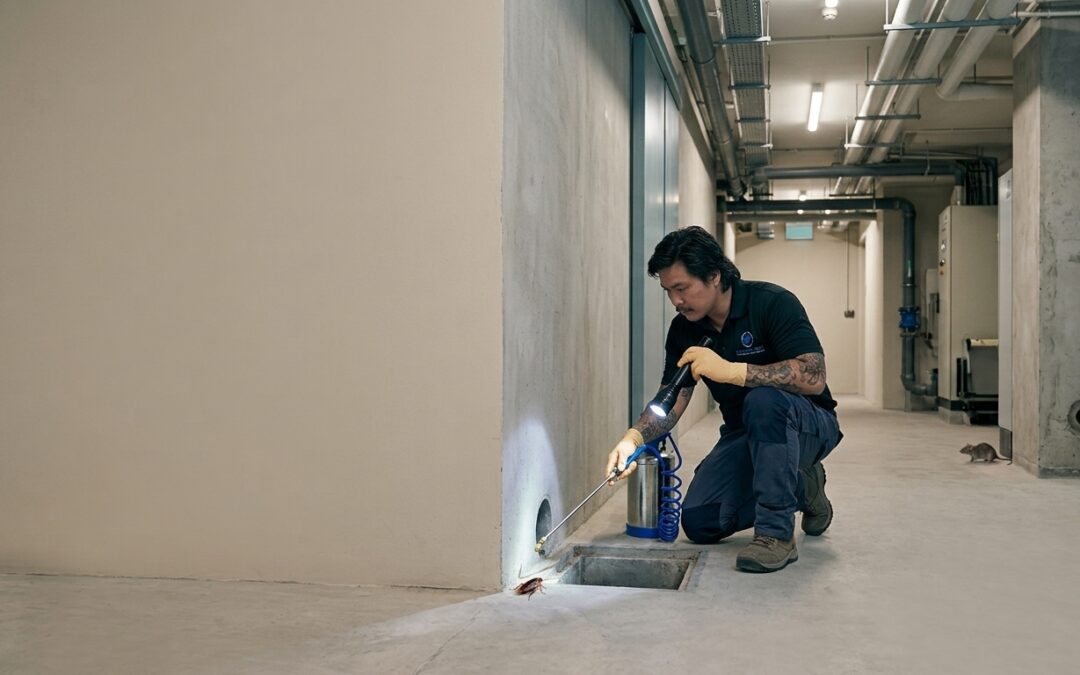
Commercial buildings in Singapore face pest risks that go beyond any single industry’s checklist — shared basements, waste centres, common corridors, and even routine renovation work can introduce or spread pest activity across an entire building, not just one tenant’s unit. This guide covers the pest risks every commercial building faces regardless of sector, the shared zones that fall between tenant responsibilities, and why renovation deserves far more pest-control attention than it typically gets.
Key Takeaways
- Cockroaches, rodents, ants, flies, mosquitoes, termites and bed bugs each pose distinct risks in commercial buildings, with different preferred zones and warning signs.
- Multi-tenant buildings have shared risk zones — basements, car parks, bin chutes, common corridors — that fall outside any single tenant’s direct control but affect the whole building.
- Renovation work is a genuine pest risk trigger, disturbing pests already living in voids and cavities rather than eliminating them, and often leaving new entry points unsealed.
- A gap of roughly six millimetres around a plumbing penetration is enough for a young rat to pass through, which is why post-construction sealing standards matter as much as the renovation work itself.
- Ignoring pest activity in a commercial building carries health, reputational and operational risks, even outside regulated sectors like food and healthcare.
- Effective commercial pest management typically requires coordination between building management and individual tenants, since shared zones can’t be addressed by one party alone.
Why Commercial Buildings Attract Pests Regardless of Industry
Singapore’s climate does a lot of the work here. Warm, humid conditions persist year-round, giving pests ideal breeding conditions regardless of season or sector. Add the density typical of commercial buildings — multiple tenants, shared infrastructure, constant foot traffic, and building services running through common voids and shafts — and you get an environment where pest activity in one part of the building rarely stays contained to that one part for long.
This is worth understanding upfront: a pest problem in a commercial building isn’t purely a function of how clean any single tenant keeps their own space. Shared systems, common areas and structural connections between units mean pest risk in a commercial building is, to some extent, a collective issue rather than an individual one. A tenant who keeps an immaculate pantry can still see recurring cockroach activity if the building’s shared waste centre two floors down is poorly managed, simply because the pests moving through service ducts and ceiling voids don’t recognise lease boundaries the way property agreements do.
This distinction matters practically, not just conceptually. It changes who should be responsible for what, and it explains why a tenant who’s done everything right on their own floor can still end up dealing with a pest problem that originated somewhere else in the building entirely.
The Core Pest Risks Every Commercial Building Faces
| Pest | Typical Zones | Primary Risk |
|---|---|---|
| Cockroaches | Pantries, bin centres, drains, dark undisturbed spaces | Contamination, allergen and asthma triggers, rapid breeding |
| Rodents | Basements, ceiling voids, service ducts, waste areas | Structural and wiring damage, disease transmission, fire risk |
| Ants | Pantries, desks, spillage-prone areas | Contamination of food, nuisance to staff |
| Flies | Waste centres, drains, damp areas | Pathogen transmission, nuisance in customer-facing areas |
| Mosquitoes | Planter boxes, stagnant water, construction areas | Dengue and other mosquito-borne disease risk |
| Termites | Structural timber, perimeter soil, wall cavities | Costly, often undetected structural damage |
| Bed Bugs | Soft furnishings, cracks and crevices | Bites, discomfort, difficult to contain once spread |
Cockroaches and rodents tend to be the most consistently reported issues across commercial buildings in Singapore, largely because they thrive on exactly the conditions dense, multi-tenant buildings tend to have in abundance: warmth, food residue, and undisturbed voids running behind walls and above ceilings.
High-Risk Zones in Multi-Tenant Commercial Buildings
Some of the highest-risk areas in a commercial building don’t belong to any single tenant, which is part of why they’re so often overlooked.
Basements & Car Parks Poorly lit, often damp, and rarely inspected as part of routine tenant housekeeping, basements and car parks are prime rodent territory. Standing water, stored waste and infrequent human presence all favour extended, undisturbed activity.
Bin Chutes & Waste Centres Shared waste disposal points concentrate exactly what pests are looking for — food residue, moisture, and shelter — in one heavily trafficked but rarely deep-cleaned location.
Shared Pantries & Common Corridors In buildings with shared facilities, communal pantries or corridor vending areas can become pest hotspots precisely because no single tenant feels fully responsible for keeping them clean.
Building Perimeter Landscaping, drainage and building entry points around the perimeter affect every tenant inside, but usually fall under building management’s purview rather than any individual lease.
Renovation as a Pest Risk Trigger
Renovation is worth treating as a pest event in its own right, not just a construction project. When walls are opened, floors lifted, and materials moved, pests that have been living undisturbed in structural voids and cavities don’t simply vanish. In Singapore’s dense commercial buildings, they typically relocate — sometimes into neighbouring units, sometimes into previously unaffected parts of the same property.
This matters because renovation work routinely creates new pest entry points that aren’t part of the original construction specification. Pipe penetrations, conduit runs and wall openings created during renovation are potential access routes unless pest-exclusion sealing is explicitly specified and checked, which contractors focused on completing installations to spec often don’t prioritise on their own. It’s worth understanding just how little space is required: a gap of roughly six millimetres around a plumbing penetration is enough for a young rat to pass through — a gap easily created during renovation and just as easily overlooked once the wall is closed up and the opening is no longer visible.
Renovation also tends to create temporary water collection points through plumbing modifications, drainage rerouting, or pooling in construction trenches, all of which can become mosquito breeding sites if not managed proactively during the works.
For commercial properties undergoing renovation while partially occupied, a pre-renovation pest assessment followed by post-renovation verification is a far more reliable approach than assuming the building is clean simply because the construction work looks complete.
Planning renovation work on a commercial property? Precision Pest can carry out a pre- and post-renovation pest assessment to catch displaced activity and unsealed entry points before they become a bigger problem. Get in touch to arrange one.
Health and Business Risks of Ignoring Commercial Pest Problems
Pest activity in a commercial building carries consequences that extend well past a single unpleasant sighting. Cockroach allergens are a recognised trigger for asthma and allergic reactions among sensitive individuals, meaning a persistent infestation can genuinely affect employee health, not just comfort. Rodents are associated with disease transmission risks including leptospirosis, and their gnawing behaviour creates real fire hazards through damaged electrical wiring — a risk that applies to shared building infrastructure just as much as any individual tenant’s fit-out.
There’s a reputational dimension too. A pest sighting during a client visit, or a negative online review mentioning pests, can affect a business’s standing in ways that are disproportionate to the actual scale of the problem — a single visible cockroach tends to leave a stronger impression than the underlying pest management history would suggest is warranted. For businesses sharing a building with other tenants, this risk compounds: a pest sighting doesn’t always get attributed to the specific tenant where it occurred, and a building’s overall reputation can suffer even when only one unit has an active issue.
Shared Responsibility in Multi-Tenant Buildings
Because so many of the highest-risk zones in a commercial building sit outside any individual tenant’s lease boundary, effective pest management usually requires coordination between building management and tenants rather than relying on either party alone. Building management is typically best placed to manage basements, car parks, waste centres and perimeter risk, while individual tenants remain responsible for what happens inside their own units — pantry hygiene, desk-level housekeeping, and prompt reporting of any activity they notice.
Buildings that treat pest management as a purely tenant-level responsibility tend to see recurring issues in the shared zones nobody has clearly claimed ownership of, while buildings that coordinate a building-wide programme alongside individual tenant efforts generally see more consistent, longer-lasting results.
In practice, this coordination doesn’t need to be complicated. A shared pest management contract covering common areas, paired with clear guidance for individual tenants on their own housekeeping responsibilities, closes most of the gap. What tends to cause problems is the absence of any explicit agreement at all — building management assuming pest control is a tenant matter, and tenants assuming shared areas are being handled centrally, with neither assumption being quite true. Building managers and MCST committees are often best placed to initiate this conversation, since they’re the party with visibility across the whole property rather than just one leased unit.
General Prevention Checklist for Commercial Buildings
- Waste collected and disposed of regularly, with bin areas kept clean and covered
- Food stored in sealed containers in all pantry and breakroom areas
- Leaking pipes, clogged drains and stagnant water addressed promptly
- Structural gaps, cracks and unsealed penetrations checked and closed
- Landscaping and perimeter areas kept free of overgrown vegetation and standing water
- Routine inspections scheduled for basements, car parks and other low-traffic zones
- Staff and tenants briefed on reporting procedures for any pest sightings
DIY vs Professional Pest Management
| DIY Housekeeping | Professional Pest Management | |
|---|---|---|
| Best for | Tenant-level hygiene, early detection | Structural work, shared-zone treatment, monitoring |
| Scope | Cleaning, food storage, waste management within a unit | Full building inspection, baiting, exclusion, documentation |
| Coordination | Individual tenant responsibility | Often coordinated with building management for shared zones |
| Limitations | Cannot address basements, perimeter risk or structural entry points | Requires scheduled visits and contracted cost |
How Often Should Commercial Buildings Get Pest Inspections?
Frequency depends heavily on sector and building type. Food and healthcare tenants typically require closer to monthly professional visits given regulatory expectations, while general office or retail tenants in a well-maintained building may manage with quarterly inspections. Buildings with a history of pest activity, older infrastructure, or recent renovation work generally warrant a tighter schedule than the general baseline until any underlying issues are confirmed resolved.
How Precision Pest Supports Commercial Buildings
At Precision Pest, we work with both individual commercial tenants and building management teams to address pest risk across the areas that actually drive it — not just the units where activity happens to be reported. Our commercial pest control programmes cover shared zones like basements, waste centres and perimeter risk alongside tenant-specific treatment, and our teams are experienced in coordinating pre- and post-renovation pest assessments for buildings undergoing works while still occupied. Every visit includes documentation suited to whichever compliance standard applies to your specific tenants, from general commercial hygiene through to sector-specific audit requirements.
Frequently Asked Questions About Common Pests Risks
Cockroaches and rodents are the most consistently reported, followed by ants, flies, mosquitoes, termites and, less frequently, bed bugs, each associated with different zones of the building.
They tend to be poorly lit, damp and rarely inspected as part of routine tenant housekeeping, which gives rodents in particular an undisturbed environment to establish themselves.
Yes. Renovation disturbs pests already living in structural voids, often displacing rather than eliminating them, and frequently creates new unsealed entry points around pipes, conduits and wall openings.
Roughly six millimetres around a plumbing penetration is enough, which is why pest-exclusion sealing should be part of any renovation specification, not an afterthought.
Typically building management, since areas like basements, car parks, waste centres and the building perimeter fall outside any individual tenant’s lease boundary.
It depends on the tenant mix. Food and healthcare tenants generally need closer to monthly inspections, while general office or retail tenants may manage with quarterly visits in a well-maintained building.
Yes, particularly through shared voids, service ducts and structural connections common in multi-tenant buildings, which is why isolated, unit-level treatment doesn’t always resolve building-wide issues.
Yes. Cockroach allergens are a recognised asthma and allergy trigger, and rodents carry disease transmission risks, meaning pest activity is a genuine health consideration, not just a hygiene one.
Ideally both — a pre-renovation assessment to establish a baseline and identify existing activity, and post-renovation verification to confirm new entry points have been properly sealed.
Yes. IPM principles — prevention, monitoring and targeted treatment — apply well across shared building zones and individual tenant spaces alike, reducing chemical use while addressing root causes.
Summary
Pest risk in a commercial building rarely respects tenant boundaries. Shared zones like basements, waste centres and building perimeters, along with disruptive events like renovation, affect the whole building regardless of how carefully any single tenant manages their own space. Understanding which pests pose the greatest risk, where the shared blind spots typically sit, and why renovation deserves proactive pest-control attention rather than an afterthought puts building management and tenants in a much stronger position to prevent problems before they spread.
If you manage or occupy a commercial building and would like a site assessment covering both tenant and shared-zone risk, Precision Pest offers customised pest management programmes across Singapore. Contact our team to get started.
Explore Expert Pest Control Guides
READY TO PROTECT YOUR PROPERTY?