
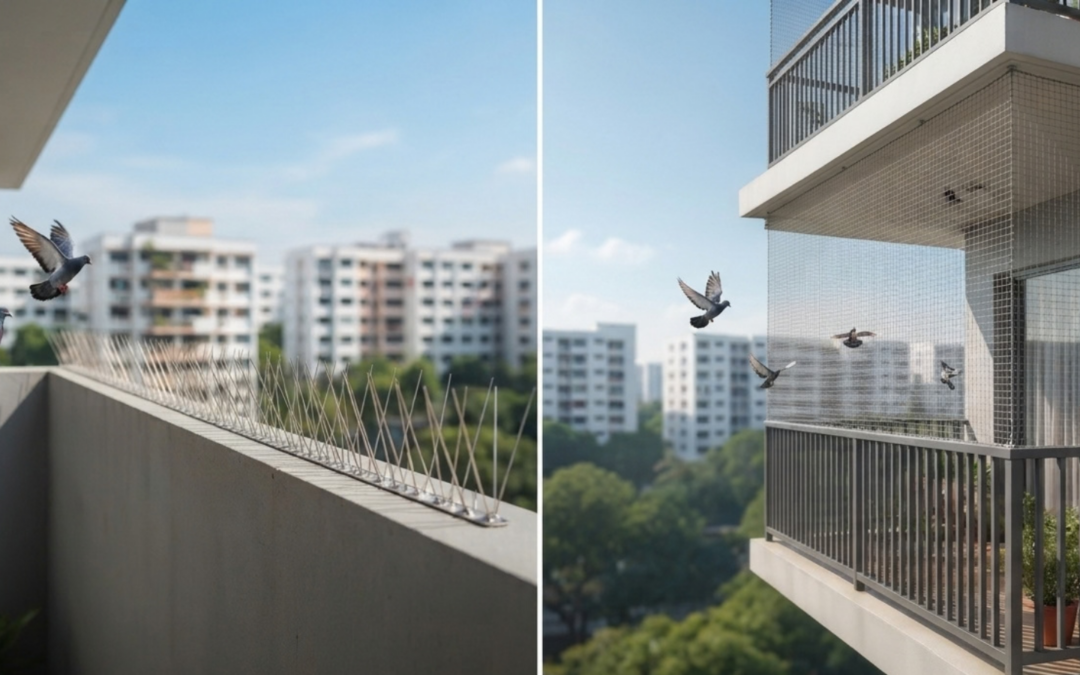
Quick answer: Bird spikes stop birds from landing on narrow surfaces such as ledges, parapets and signage. Bird netting stops birds from entering an enclosed space such as a service yard, balcony, loading bay or warehouse roof. When it comes to bird spikes vs bird netting, neither is better in every situation. The right choice depends on what the birds are doing on your property: perching, roosting or nesting.
Key Takeaways
- Spikes are for perching. They work on narrow ledges and edges where pigeons sit, rest and leave droppings.
- Netting is for exclusion. It is the more reliable option wherever birds are nesting or entering a covered space.
- Nesting pressure decides the outcome. Pigeons that have already nested on a ledge will often push past spikes. Netting removes access completely.
- Most failures come from installation, not the product. Wrong mesh size, gaps at the edges, spikes on ledges that are too wide, and fixing over droppings are the usual causes.
- Many properties need both methods. Commercial buildings often net open structures and spike the surrounding ledges.
- Food sources still have to go. No deterrent holds for long if birds are being fed nearby. Feeding wildlife in Singapore can lead to fines of up to $10,000.
Why This Decision Matters
If pigeons are using your aircon ledge as a toilet, or mynas have moved into your warehouse rafters, you probably want the problem gone quickly. The temptation is to buy whichever deterrent you see first. That is how many homeowners and facility managers in Singapore end up paying twice: once for the wrong solution, and again for the one that should have been installed in the first place.
This guide is for HDB residents, condominium owners, landed homeowners, MCST managers and anyone running a warehouse, factory or food business. The advice applies to the pest birds most common in Singapore, especially pigeons, with notes on smaller species such as sparrows and mynas. You will learn how each method works, where each one fails, how to match the method to the bird behaviour you are seeing, and what to expect from installation and maintenance in our climate.
What Is the Difference Between Bird Spikes and Bird Netting?
Bird spikes are strips of blunt, upright rods made from stainless steel or polycarbonate. They are fixed along ledges, beams and edges so that birds cannot find a flat, stable place to land. Spikes do not pierce or injure birds. They simply make a surface uncomfortable to stand on.
Bird netting is a mesh barrier, usually made from UV-stabilised polyethylene, that is tensioned across an opening to physically block birds from entering a space. When it is installed properly, birds cannot reach the protected area at all. That is why netting is the standard method for stopping nesting.
Put simply, spikes change the surface and netting removes the access. That one difference explains most of what follows.
How Do Bird Spikes Work?
Pigeons need a stable footing to land, rest and roost. A row of spikes breaks up that footing. A bird that tries to land finds nowhere to settle, gives up and moves elsewhere.
Where bird spikes work well
- Aircon ledges and compressor tops
- Parapet walls and roof edges
- Window sills and narrow ledges
- Signboards, lamp posts and beams
- Pipes, conduits and gutter edges
Stainless steel or polycarbonate?
Stainless steel spikes last longer under Singapore’s sun and rain, and they suit high, exposed positions that are hard to reach for replacement. Polycarbonate spikes are lighter and less visible. They are often used on signage or decorative surfaces where appearance matters. Both are effective when they are sized and positioned correctly.
Where bird spikes fail
Spikes struggle in three situations:
- The ledge is too wide. If a ledge is wider than the spike strip, birds simply land beside it. Wide ledges need multiple rows or a different method.
- Debris builds up. Leaves, twigs and droppings collect between the spikes. Over time, they form a platform. We regularly see pigeons nesting on top of neglected spikes.
- The birds are already nesting. Pigeons are strongly attached to their nesting sites. A nesting pair will tolerate a lot of discomfort to reach a site they have already chosen, and spikes alone rarely stop them.
How Does Bird Netting Work?
Netting works by exclusion. Instead of making a surface uncomfortable, it blocks the bird from reaching the space at all. If a bird cannot get into your service yard, it cannot nest there, roost there or leave droppings there.
Where bird netting works well
- HDB service yards and balconies
- Condominium balconies and planter areas
- Aircon ledges that are recessed or enclosed on three sides
- Warehouse roof spaces, rafters and loading bays
- Open courtyards, atriums and car park structures
- Rooftop plant areas and under solar panels
Why mesh size and material matter
Mesh size has to match the bird. Common industry practice is a mesh of around 50 mm for pigeons. Smaller birds such as sparrows can pass through that, so sites troubled by smaller species need a much tighter mesh, typically around 19 mm. Choosing the wrong size is one of the most common reasons netting fails.
Material matters too. Singapore’s UV exposure breaks down cheap, untreated nets quickly. UV-stabilised netting holds its strength far longer outdoors.
Where bird netting fails
- Gaps at the edges. A pigeon only needs a small opening to squeeze through. Edges that are poorly fixed or not tensioned are the weak point of most netting jobs.
- Sagging. A slack net can be pushed aside. It can also trap birds, which then need to be released.
- Poor anchoring. Fixings that loosen in the rain or wind let the net pull away from the frame.
- Birds sealed inside. Netting a space while birds are still inside, or before nests and eggs have been removed, creates a welfare problem and a mess.
Bird Spikes vs Bird Netting: Side-by-Side Comparison
| Factor | Bird Spikes | Bird Netting |
| How it works | Prevents landing on a surface | Blocks access to a space |
| Best for | Perching and roosting on narrow ledges | Nesting, roosting and entry into covered areas |
| Level of protection | Partial: protects the treated surface only | Full: protects the entire enclosed area |
| Handles nesting pressure | Weak | Strong |
| Visibility | Visible up close, low profile from a distance | Close to invisible when well installed |
| Maintenance | Clear debris and check fixings | Check tension, edges and tears |
| Typical locations | Parapets, sills, signage, beams | Service yards, balconies, rafters, loading bays |
| Effect on the bird | Discourages landing, does not injure | Excludes, does not injure when maintained |
| Lifespan | 5–10 years with proper maintenance | 5–10 years with proper maintenance |
Which Should You Choose? A Decision Guide by Bird Behaviour
The fastest way to choose is to watch what the birds are doing. Look at the site at different times of day, including early morning and late evening.
| What you see | What it means | Recommended method |
| Birds landing briefly on a ledge, a few droppings | Perching | Spikes |
| Birds sitting for hours, heavy droppings below | Roosting | Spikes on narrow ledges, netting on wide or recessed ones |
| Twigs, nesting material, eggs or chicks | Nesting | Netting, after the nest is removed |
| Birds flying into a covered area | Entry | Netting |
| Birds on several surfaces around a structure | Mixed use | Netting the structure, spikes on surrounding ledges |
When should you combine both methods?
Combining the two is common on commercial and industrial sites. A warehouse might net its roof space to stop nesting above stored goods, then spike the external ledges and canopy edges where birds gather before trying to get in. Spikes on their own leave the interior exposed. Netting on its own still leaves droppings on the façade. Used together, they protect both.
Which Works Best for Your Property Type?
HDB flats
Most HDB bird problems start on the aircon ledge or in the service yard. A ledge that is open along its length often responds to spikes. A recessed ledge where pigeons are nesting usually needs netting. Netting is also the practical choice for service yards where laundry is hung. Before you install anything on the external face of your flat, check with your town council, because installations that affect common property or the building’s appearance can be subject to rules.
Condominiums
Condominium residents should check their MCST by-laws before installing netting on balconies, since many developments control what can change the building’s external look. MCSTs managing pigeons in common areas, such as roof edges, car park structures and pool pavilions, usually get better results from a coordinated building-wide plan than from residents fixing problems unit by unit, because birds simply move to the next untreated ledge.
Landed homes
Landed properties have more surfaces to cover: roof edges, gutters, porch beams, pergolas and, increasingly, solar panels. Spikes suit rooflines and beams. The gap under solar panels is a favourite pigeon nesting spot and is normally sealed with a mesh barrier rather than spikes.
Warehouses and industrial premises
Large open structures, high rafters and loading bays that stay open all day make warehouses attractive to pigeons and mynas. Netting of the roof space is usually the core of the solution, supported by spikes on external ledges. Bird control here sits within a wider programme. Our guide to warehouse and logistics pest control covers how it fits alongside rodent and insect control.
Restaurants, food factories and food establishments
For food businesses, birds are a contamination risk, not just a nuisance. Droppings near loading bays, ingredient storage or outdoor seating can raise food safety concerns during audits. Exclusion is the priority, and records of the work matter. See our articles on restaurant pest control and HACCP and pest control for food manufacturing plants for how bird proofing supports compliance.
Not sure which method your property needs? Precision Pest provides a complimentary site inspection to identify how birds are using your property and recommend the right combination of spikes, netting or other deterrents. Learn more about our residential bird control and commercial bird control programmes.
Why Do Bird Spikes and Netting Fail?
Most “it didn’t work” stories come from how the deterrent was installed, not from the product itself. These are the mistakes we see most often in Singapore properties.
- Installing over droppings and old nests. Droppings leave a scent and a visual cue that tell birds the site is safe. Spikes glued onto dirty surfaces also detach faster. Clean and sanitise first.
- Using spikes where birds are nesting. Spikes discourage landing. They are not designed to stop a committed nesting pair.
- Choosing the wrong mesh size. A pigeon-sized mesh will not stop sparrows. An unnecessarily fine mesh costs more and collects more dirt.
- Leaving gaps. One unsealed corner at the top of a net defeats the whole installation.
- Covering only part of the problem. Spiking one ledge pushes birds to the next. Treat all the surfaces they use, not just the one you notice.
- Ignoring the food source. If someone nearby is feeding birds, or bins are left open, pigeons will keep testing your defences.
- Skipping maintenance. Spikes that fill with debris and nets that sag gradually stop working.
What about the food source?
Physical deterrents only treat where birds land. The reason they are in the area in the first place is usually food. Singapore’s government agencies manage pest birds mainly by removing food sources and modifying habitats, and feeding wildlife is prohibited. According to NParks, people caught feeding wildlife can face fines of up to $10,000. For businesses, good bin management and clean outdoor areas are part of keeping a bird problem from coming back. Our environmental sanitation programme addresses these site conditions.
How Long Do Spikes and Netting Last in Singapore’s Climate?
With proper maintenance, both bird spikes and netting can last 5 to 10 years. Singapore’s conditions test them hard. Strong UV, heavy rain, high humidity and the occasional strong gust all wear down materials and fixings.
The difference between a deterrent that lasts two years and one that lasts ten is usually inspection and upkeep, not the brand.
Bird Deterrent Maintenance Checklist
✔ Clear leaves, twigs and droppings from spike strips
✔ Check that spikes are still firmly attached and upright
✔ Inspect netting edges and corners for gaps
✔ Look for sagging, tears and loose fixings
✔ Check whether any birds are trapped behind or within the net
✔ Watch for birds shifting to nearby untreated ledges
✔ Inspect more often after heavy storms
✔ Keep records of each inspection for commercial premises
What Affects the Cost of Bird Spikes and Netting?
Every property is different, so a fair quote depends on a site visit. The main factors are:
- Area and length. Netting is priced by area, spikes by the length of ledge treated.
- Height and access. Work at height needs safety equipment and qualified technicians. High-rise façades, warehouse rafters and rooftops cost more to reach than a ground-level ledge.
- Material. Stainless steel spikes and heavier-duty netting cost more upfront but generally last longer.
- Cleaning and sanitising first. Heavy droppings must be removed before installation.
- Nest removal. Active nests need to be removed carefully before exclusion.
- Combined methods. Sites needing both spikes and netting are priced as a single plan.
Cheaper quotes often leave out the cleaning, the edge sealing or the maintenance, which are exactly the elements that make the installation last.
Can You Install Bird Spikes or Netting Yourself?
DIY can work for small, low-risk jobs. A single ground-floor window sill or an easily reached porch beam is a reasonable weekend task. Larger or higher jobs are a different matter.
| Factor | DIY Installation | Professional Installation |
| Suitable for | Small, low, easily reached ledges | Aircon ledges, façades, rooftops, warehouses |
| Safety | Risky above ground level | Work-at-height safety measures applied |
| Diagnosis | Guesswork about bird behaviour | Assessment of perching, roosting and nesting |
| Mesh and material choice | Often off the shelf | Matched to species and site |
| Cleaning | Often skipped | Droppings removed and sanitised first |
| Coverage | Usually the obvious spot only | All surfaces the birds use |
| Maintenance | Rarely scheduled | Follow-up inspections |
Please do not climb onto an aircon ledge or lean out of a high-floor window to fix spikes or netting. No pigeon problem is worth that risk.
Is Bird Proofing Legal and Humane in Singapore?
Yes, when it is done properly. Spikes and netting are non-lethal. They stop birds from using a space rather than harming them, which is why they are the mainstream approach for homes and businesses in Singapore.
To keep the work humane:
- Check for active nests, eggs and chicks before sealing an area.
- Make sure no birds are trapped inside before closing a net.
- Inspect nets regularly so birds that get caught can be released.
- Avoid improvised methods such as poisons or sticky substances, which can cause suffering and may break the law.
Pest-bird management in Singapore involves several agencies, including NParks, NEA, SFA and town councils, with a focus on reducing food sources and modifying habitats. Physical deterrents on your own property support that approach. Our article on NEA pest control guidelines for businesses covers the wider compliance picture for commercial premises.
What About Bird Droppings Left Behind?
Accumulated droppings are a hygiene problem in their own right. They are associated with diseases such as histoplasmosis and psittacosis, and they corrode surfaces and stain façades. Cleaning should be done with protective equipment and proper disinfection, not by dry sweeping, which can release dust. Precision Pest’s disinfection services can be combined with bird proofing so the site is clean before the deterrents go in.
When Should You Call a Professional?
Bring in professionals when:
- Birds are nesting, not just perching.
- The problem is above ground level or on an external façade.
- You have treated one spot and the birds have moved next door.
- Droppings have built up heavily.
- You run a food business, warehouse or other commercial premises where audits and records matter.
- A previous installation has failed.
A professional inspection looks at how birds are using the whole property, where they are coming from and what is attracting them. You can read more about what happens during a commercial pest inspection and the common pest risks in commercial buildings.
Why Choose Precision Pest for Bird Control?
Precision Pest installs bird spikes, UV-resistant netting and other deterrents for homes and businesses across Singapore. Every job starts with an inspection of how birds are using your property, followed by a customised plan, careful installation and follow-up. For commercial clients, bird control can be built into an Integrated Pest Management (IPM) programme with documented service reports. Our methods are non-lethal and focused on long-term prevention.
Frequently Asked Questions
For pigeons perching on narrow ledges, spikes work well. For pigeons nesting in a service yard, balcony, ledge recess or roof space, netting is more effective, because it blocks access entirely.
No. Bird spikes have blunt tips and are designed to stop birds from landing, not to injure them. They work by making a surface unstable and uncomfortable.
Yes, if the spikes are not maintained. Leaves, twigs and droppings can collect between the spikes and create a base for a nest. Regular cleaning prevents this.
Well-installed netting in a neutral colour is difficult to see from a distance. Black and transparent nets are commonly used where appearance matters.
Many HDB residents install netting on service yards and aircon ledges. Check with your town council before installing anything on the external face of your flat, and use a professional for anything above ground level.
Often, yes. Many condominium by-laws control changes to the building’s exterior, including balcony netting. Check with your MCST before installation.
With proper maintenance, both can last 5 to 10 years in Singapore. Lifespan depends on material quality, UV exposure, installation quality and how often they are inspected.
The usual reasons are that the birds are nesting rather than perching, the ledge is wider than the spikes, debris has built up, or there is a food source nearby. Netting or a combined approach is often needed.
Yes. Feeding wildlife, including pigeons, is prohibited in Singapore. According to NParks, offenders can be fined up to $10,000.
There is no single best method. Netting gives the most complete protection for enclosed spaces, spikes are effective for narrow perching surfaces, and many properties need both, along with removing food sources.
Summary
Bird spikes and bird netting solve different problems. Spikes stop birds from landing on narrow surfaces. Netting stops them from getting into a space. Watch what the birds are doing: perching usually calls for spikes, nesting and entry usually call for netting, and mixed problems often need both. Whichever method you choose, clean the site first, seal every gap, deal with nearby food sources and keep up with maintenance. That is what separates an installation that lasts from one that fails within a few months.
Pest Control Advice & Resources
Get the Right Bird Control Solution for Your Property