

There’s no single correct answer to how often a commercial property needs pest inspections — the right frequency depends on your industry’s risk level, building age, pest history and any audit requirements you’re working toward. Most Singapore businesses fall somewhere between monthly and quarterly, but the more useful approach is understanding which factors should push that frequency up or down for your specific property, rather than defaulting to whatever a generic contract offers.
Key Takeaways
- Inspection frequency should be driven by risk factors — industry, building age, location and pest history — not a flat, one-size-fits-all schedule.
- Most Singapore commercial properties fall between weekly and quarterly inspections, with food and healthcare businesses generally needing the tightest cycles.
- Not every zone of a property needs the same inspection frequency; high-risk areas like storage and waste zones warrant more frequent attention than low-traffic office corners.
- A confirmed pest issue should trigger a temporary increase in inspection frequency, typically with a follow-up visit 3–4 weeks after treatment, before tapering back to routine.
- Singapore’s consistent tropical climate means there’s no true “off season” for pests, though heavier rainfall periods can still justify a temporary bump in monitoring.
- Over-servicing is possible too — a low-risk premises with a clean history doesn’t necessarily need the same frequency as a high-risk food facility, and paying for excessive visits doesn’t improve outcomes on its own.
Why There’s No Single Right Answer
Ask five different commercial pest control providers how often a business needs inspections, and you’ll likely get five different answers — not because any of them are wrong, but because the honest answer genuinely depends on the property in question. A boutique office in a newly built Grade A building has a very different risk profile from a 30-year-old warehouse next to a food waste collection point, even though both are technically “commercial premises.”
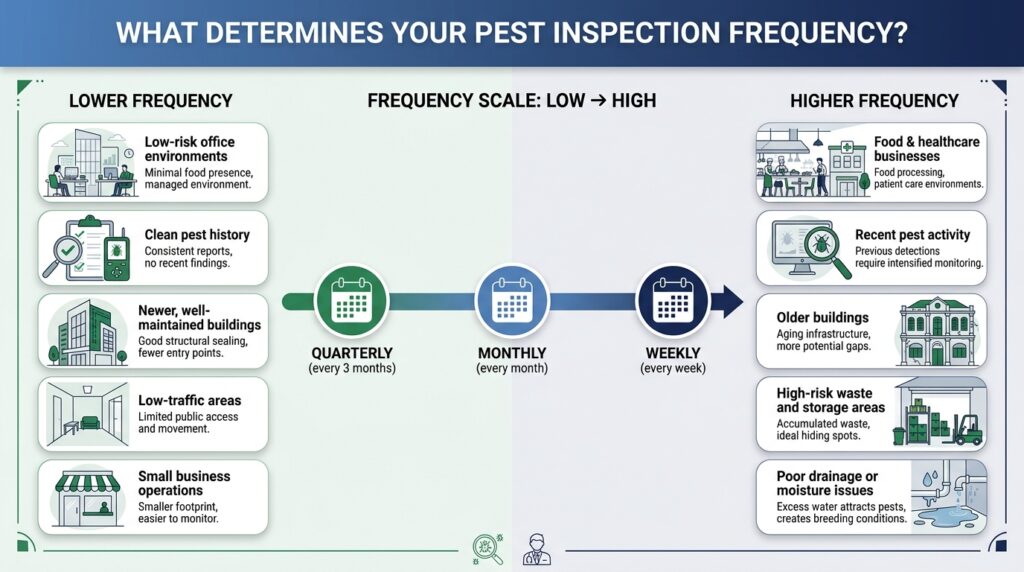
The factors that matter most are fairly consistent across providers, even if the specific recommendations vary: industry and regulatory exposure, building age and condition, geographic location, pest activity history, and any certification or audit obligations the business is working toward. Understanding these factors well enough to ask the right questions puts a facility manager in a much stronger position than simply accepting whatever frequency a provider defaults to.
The Five Factors That Actually Determine Frequency
Industry and Regulatory Exposure Food businesses answer to SFA and NEA in a way that a general office doesn’t, which typically pushes their required frequency toward the weekly-to-fortnightly end of the range. Healthcare facilities face similarly tight expectations given patient vulnerability.
Building Age and Condition Older buildings tend to have more cracks, gaps and ageing infrastructure that create pest entry points, which is why a facility manager overseeing an older property should generally expect a tighter inspection schedule than one in newer, well-sealed premises.
Geographic Location Properties near food waste collection points, construction sites, green spaces or drainage systems face higher ambient pest pressure than those in cleaner, more isolated locations, regardless of how well-maintained the building itself is.
Pest Activity History A property with a documented history of infestation — even one that’s since been resolved — generally warrants closer monitoring than a property with a clean track record, since past activity often indicates conducive conditions that haven’t been fully eliminated.
Certification and Audit Requirements Businesses pursuing or maintaining certifications like HACCP, ISO 22000, FSSC 22000 or BRC often have minimum inspection frequencies specified as part of the certification scheme itself, which should take precedence over general industry guidelines where they apply.
None of these five factors operates in isolation, and it’s the combination that usually determines where a specific property lands. A newer building in a food-handling sector might still warrant a tighter schedule than an older office building purely because of the regulatory exposure, while an ageing warehouse storing non-perishable goods with no audit obligation might reasonably sit at the lower end of its sector’s typical range despite the building’s condition. Facility managers weighing up a provider’s recommended frequency are on firmer ground asking which of these five factors specifically drove that number, rather than accepting a generic answer at face value.
Typical Inspection Frequency by Sector
| Sector | Typical Frequency | Primary Driver |
| Restaurants & F&B | Weekly to fortnightly | SFA compliance, high contamination risk |
| Food Manufacturing | Weekly to bi-weekly | FSMS/HACCP prerequisite requirements |
| Healthcare Facilities | Weekly to fortnightly | Patient vulnerability, infection control |
| Warehouses (food/pharma) | Weekly to fortnightly | Inventory contamination risk, audit schemes |
| Warehouses (general goods) | Monthly | Lower contamination sensitivity |
| Offices | Monthly to bi-monthly | Lower regulatory stakes, employee comfort |
| Retail & Shopping Centres | Fortnightly to monthly | High foot traffic, food court exposure |
These ranges reflect general industry patterns rather than fixed rules — a specific property’s actual risk factors can justify moving toward either end of its sector’s typical range, or occasionally outside it entirely.
If you’re unsure where your business falls on this spectrum, Precision Pest can run a free site assessment and recommend a frequency based on your property’s actual risk factors rather than a generic default. Get in touch to arrange one.
Tiered Frequency: Not Every Zone Needs the Same Schedule
One detail that gets lost in most general advice is that a single property doesn’t need every zone inspected at the same frequency. A more useful model breaks inspection cadence down by zone risk rather than applying one blanket schedule across the entire premises:
- Daily or near-daily staff-level checks for high-risk areas like storage, loading docks and food prep zones, where spills, moisture and frequent openings create constant pest pressure.
- Weekly professional or staff checks for perimeter areas, waste disposal zones and other spaces where entry points and sanitation conditions need regular verification.
- Monthly or less frequent professional inspections for hard-to-reach areas like crawl spaces, ceiling voids and behind fixed equipment, where activity develops more slowly but is harder to spot without a dedicated check.
This tiered approach also helps make sense of why a single business might reasonably have both a monthly professional pest control contract and a daily internal checklist running in parallel — they’re addressing different risk tiers, not duplicating the same coverage.
Routine Maintenance vs Follow-Up Inspection
It’s worth separating two different things that often get bundled under “pest control frequency”: the routine maintenance schedule a business runs indefinitely, and the follow-up inspection cadence that applies after a confirmed issue.
Routine maintenance is the ongoing baseline — monthly, fortnightly, whatever fits the property’s general risk profile. A follow-up inspection is different: after treating a confirmed infestation, a check-in roughly 3–4 weeks later is typical to confirm the treatment worked, followed by further monitoring every few months until the provider is confident the issue is genuinely resolved, not just temporarily suppressed. Businesses sometimes assume that once a visible pest problem is treated, they can drop straight back to the standard routine schedule — but skipping the follow-up step is one of the more common reasons pest problems appear to “come back” a few months later, when in reality they were never fully confirmed as resolved in the first place.
Signs Your Business Needs More Frequent Inspections
- Recurring pest sightings despite treatment, suggesting the underlying conducive conditions haven’t been addressed
- A recent renovation or construction nearby, both of which can disturb or displace existing pest populations
- New certification or audit requirements that specify a minimum inspection frequency
- A change in building tenancy mix, particularly the addition of an F&B tenant in a shared building
- Staff regularly reporting sightings between scheduled visits, which usually indicates the current frequency isn’t keeping pace with actual activity
- A shift in surrounding land use, such as new construction breaking ground nearby, which frequently displaces rodent populations toward the nearest stable building
Any one of these on its own might not justify a change, but two or more occurring together is generally a reliable signal that the current schedule has fallen behind the property’s actual risk level, rather than simply reflecting a run of bad luck.
Signs You Might Be Over-Servicing
It’s less commonly discussed, but genuinely possible to pay for more frequent pest control than a low-risk premises actually needs. If a business has a consistently clean inspection history, low foot traffic, no food handling, and no specific audit requirement driving frequency, a weekly or fortnightly schedule may simply be more than the risk profile justifies. This isn’t an argument for skipping pest control altogether — it’s a case for matching frequency to actual risk rather than defaulting to the most cautious option available, particularly for smaller businesses working with tighter budgets. A straightforward conversation with your provider about your property’s actual activity history is usually enough to right-size the schedule in either direction.
How Seasonal Factors Affect Frequency in Singapore
Singapore doesn’t have a genuine “off season” for pests the way temperate countries do — the consistent warm, humid climate keeps most pest species active year-round. That said, periods of heavier rainfall can still increase rodent activity in particular, as they seek dry shelter indoors, which may justify a temporary increase in monitoring during especially wet stretches rather than treating the schedule as fixed regardless of conditions.
What Happens During a Routine Inspection Visit
A properly run inspection visit isn’t just a walk-through looking for visible pests. It typically includes checking known harbourage zones and entry points, reviewing any monitoring devices or bait stations placed since the last visit, assessing sanitation and moisture conditions that could be attracting activity, and documenting findings in a service report that becomes part of the property’s ongoing trend record. This documentation is what makes the difference between a series of disconnected visits and a genuine monitoring programme — without it, even frequent inspections provide limited value beyond the moment they happen.
How Precision Pest Determines the Right Frequency
At Precision Pest, we don’t default every commercial client to the same schedule. Our process starts with a comprehensive site assessment covering your industry, building condition, location and any specific compliance requirements, and we recommend a frequency based on what your property actually needs rather than a one-size-fits-all package. Where a confirmed issue requires closer monitoring, we build in the appropriate follow-up cadence before tapering back to routine maintenance, and every visit is documented so you can see exactly how your property’s risk profile is trending over time.
Our commercial pest control team is happy to walk through what an appropriate frequency looks like for your specific business.
Frequently Asked Questions
Most businesses fall between weekly and quarterly, with food and healthcare businesses generally needing the tightest schedules and general offices able to manage with monthly to bi-monthly visits.
No. High-risk zones like storage and waste areas often warrant daily or weekly checks, while low-traffic areas like ceiling voids may only need monthly professional inspection.
What should happen after a confirmed pest infestation is treated?
A follow-up inspection roughly 3–4 weeks later is typical to confirm the treatment worked, with further monitoring tapering over the following months rather than returning immediately to the standard schedule.
Yes. A low-risk premises with a clean history and no specific audit requirement may not need the same frequency as a high-risk food facility, and it’s worth discussing your actual risk profile with your provider.
Largely yes, given the consistent tropical climate, though heavier rainfall periods can temporarily increase rodent activity and may justify a short-term increase in monitoring.
Older buildings tend to have more structural gaps and ageing infrastructure that create pest entry points, generally warranting a tighter inspection schedule than newer, well-sealed properties
Some do. Schemes like FSSC 22000 or BRC may specify minimum frequencies as part of their audit criteria, which should take precedence over general industry guidelines where they apply.
A routine visit follows the ongoing maintenance schedule, while a post-sighting inspection is typically more frequent initially, tapering back to routine once the issue is confirmed resolved.
Yes, at least temporarily. Renovation work can disturb existing pest populations and create new unsealed entry points, both of which warrant closer monitoring in the following months.
A site assessment from a professional provider, taking into account your industry, building condition, location and any compliance requirements, is the most reliable way to determine an appropriate schedule rather than guessing based on general advice alone.
Summary
There’s no universal answer to how often a commercial property needs pest inspections, and treating the question as a single fixed number misses most of what actually matters. The right frequency comes from weighing industry risk, building condition, location, pest history and audit requirements together, then applying different cadences to different zones within the same property rather than one blanket schedule. Getting this right protects against both the risk of under-servicing a high-risk business and the unnecessary cost of over-servicing a low-risk one.
If you’d like a clear recommendation for your specific property, Precision Pest offers a free site assessment for businesses across Singapore. Contact our team to find out what frequency actually fits your risk profile.
Explore Expert Pest Control Guides
READY TO PROTECT YOUR PROPERTY?