
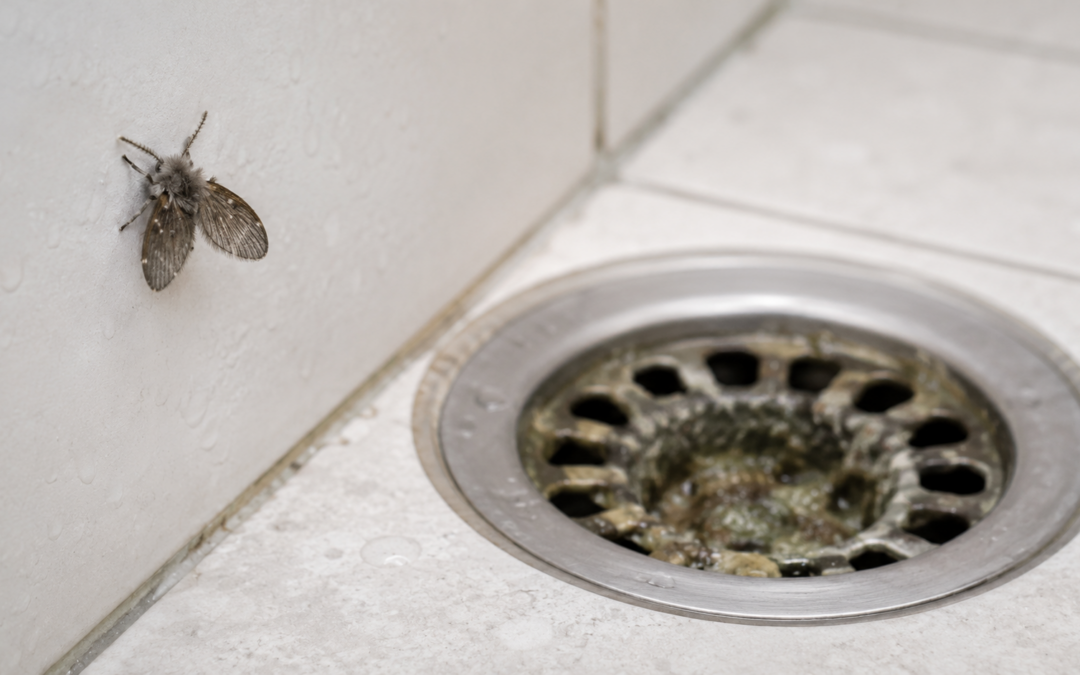
Drain flies are small, moth-like insects that breed inside Singapore’s pipes, not outside them — feeding on a bacterial slime called biofilm that builds up on drain walls within just two to four weeks in our climate. Pouring hot water or bleach down the drain kills what’s visible but rarely touches the biofilm underneath, which is why the problem so often returns within days. This guide covers what drain flies actually are, why home remedies fall short, and how professional bio-remediation treatment breaks the cycle for good — including insight from a Precision Pest technician on exactly how that process works.
Key Takeaways
- Drain flies breed inside biofilm — a slimy bacterial layer that coats drain walls — not in standing water itself, which is why boiling water and bleach rarely solve the problem long-term.
- In Singapore’s warm, humid climate, biofilm can build up to a breeding-ready level in as little as two to four weeks, depending on how frequently a drain is used.
- A single female drain fly can lay up to 100 eggs at a time, with eggs hatching within about 48 hours and reaching adulthood in roughly two weeks.
- DIY treatments like hot water typically clear only the surface-level flies, addressing an estimated 20% of the actual problem, according to Precision Pest’s own field experience.
- Professional treatment for drain flies is a two-part bio-remediation process: manual scrubbing with a bioenzyme chemical to break down biofilm, followed by pesticidal treatment to eliminate larvae and adults.
- While drain flies don’t bite, research has found them capable of carrying bacteria and, in at least one hospital study, a pathogenic yeast — making them worth taking seriously in food-handling and healthcare environments specifically.
What Are Drain Flies?
Drain flies are small, fuzzy insects that look more like miniature moths than typical houseflies. That’s exactly why they’re also known as moth flies, bathroom moth flies, filter flies or sewer gnats. The most common species in Singapore and other tropical regions is Clogmia albipunctata, a member of the Psychodidae family found worldwide, particularly in warm, humid climates like ours.
Adults measure between 2 and 5 millimetres. Their bodies and wings are densely covered in grey-brown hair, and the wings are pointed and marked with small white spots, held roof-like over the body at rest. That’s the detail that gives them a moth-like appearance despite being true flies with only two wings, not four. They’re weak fliers too — usually seen resting motionless on bathroom walls, ceilings or near sinks, hopping short distances of a few feet when disturbed rather than flying smoothly the way a housefly does.
Why Drain Flies Keep Coming Back: The Biofilm Problem
Here’s the detail that explains why so many people feel like they’re fighting a losing battle with drain flies: the flies themselves are almost never the actual problem. The problem is what’s living in your pipes.
Singapore’s hot, humid climate means household pipes rarely, if ever, fully dry out. Every day, grease, food waste, hair, soap residue and general organic debris wash down drains and sinks. Over time, this material sticks to the damp interior walls of the pipe, forming a slimy, bacteria-filled layer known as biofilm. Drain fly larvae feed on exactly this. It’s also what protects them from the treatments most people try first.
This is why hot water and bleach so often disappoint. Both adult and larval drain flies are covered in water-repellent hairs, which makes them hard to drown even in direct contact with liquid. The biofilm itself acts as a physical barrier too, shielding eggs and larvae from surface-level chemical contact. So a quick pour of hot water down the drain might kill the flies currently visible — but it does very little to the slime coating the pipe walls beneath. The breeding source is left completely intact.
Biofilm typically takes about two to four weeks to build up to a level capable of sustaining a breeding population, depending heavily on how often a particular drain or floor trap gets used, according to Precision Pest’s own service experience. Infrequently used floor traps are particularly prone to this — guest bathrooms, utility areas, drains behind furniture. Standing water in the trap evaporates between uses, drying out the seal that normally blocks flies and sewer gases from entering, while the biofilm inside keeps building undisturbed.
The Drain Fly Life Cycle in Singapore’s Climate
Understanding the timeline shows just how quickly a minor issue can escalate. A single female drain fly can lay up to 100 eggs at a time, with lifetime totals sometimes reaching 200 to 300 eggs across several egg-laying events. In Singapore’s consistent warmth, these eggs hatch in as little as 32 to 48 hours. The resulting larvae — small, worm-like creatures that feed directly on the biofilm — typically reach the pupal stage within two to three weeks, before emerging as adults capable of laying their own eggs almost immediately.
This compressed tropical life cycle is why drain fly problems go from unnoticed to established so fast. By the time a single adult fly is spotted resting on a bathroom wall, there’s a reasonable chance a much larger population is already established nearby. The visible adult is only the final step in a cycle that’s likely been running for weeks already.
Where Drain Flies Breed in Singapore Homes and Businesses
Drain flies aren’t limited to any one type of drain — anywhere organic material and moisture combine without regular disturbance is a candidate breeding site.
Bathroom floor traps are the most common source, particularly in guest bathrooms or utility areas that aren’t used daily, since infrequent water flow allows both the trap seal to dry out and biofilm to accumulate undisturbed.
Kitchen sink drains accumulate grease, food particles and soap residue at a faster rate than most other household drains, creating ideal biofilm conditions even in actively used kitchens.
Shower and bathtub drains collect hair, soap scum and skin cells, all of which contribute directly to biofilm buildup along the drain walls.
Air-conditioning condensate pans and drip lines are a commonly overlooked source, since the consistent moisture and organic buildup in these areas can sustain a small breeding population largely out of sight.
Grease traps and floor drains in F&B and commercial kitchens face significantly higher organic load than residential drains, making commercial food premises particularly prone to recurring drain fly issues if drains aren’t part of a regular sanitation and pest management routine.
Are Drain Flies a Health Risk?
Drain flies don’t bite or sting, and for most households, an isolated sighting is more of a nuisance than a genuine health concern. But it’s worth separating the actual, evidence-based risks from either extreme — dismissing them entirely, or assuming the worst.
Because drain flies live and breed in sewage-adjacent environments, they can pick up bacteria and other microorganisms on their bodies and legs. There’s a reasonable basis for mechanical transmission here — carrying pathogens from a contaminated drain onto nearby surfaces — even though the flies aren’t classified as disease vectors the way mosquitoes are. A 2024 hospital-based study identified a pathogenic yeast, Trichosporon asahii, on drain flies collected from a tertiary hospital setting. That’s a genuine, if situational, concern for healthcare and other high-hygiene-sensitivity environments specifically.
There’s also a respiratory angle. When drain flies die, their bodies and wing scales can break down into fine, hair-like fragments. In heavy, ongoing infestations, inhaling these fragments has been associated with respiratory irritation, and people with asthma or existing allergies may notice symptoms worsening around a persistent infestation. This is a reasonable, medically grounded concern, distinct from the more sensationalised claims that occasionally circulate about drain flies. It’s also why crushing them with bare hands is best avoided — doing so brings both bacteria and allergenic fragments into direct skin contact.
On the more contested end, some scientific literature has explored Clogmia albipunctata‘s potential role in myiasis — cases where fly larvae are found in human tissue, typically nasal, intestinal or urinary. A comprehensive 2022 review of the available research is notably cautious here, questioning whether existing case reports meet a strong enough standard of evidence to confirm drain flies as a genuine causative agent, rather than an incidental or misdiagnosed finding. Honestly, this remains a debated area of entomological research rather than a settled, common risk — worth knowing about, but not worth treating as an established danger.
Signs You Have a Drain Fly Problem
Beyond simply spotting an adult fly resting on a wall, a few other signs typically point to an active breeding source nearby. Small, worm-like larvae around tile cracks or the edges of a floor trap. Flies consistently reappearing in the same spot despite being swatted or cleaned away. A musty, sewage-like odour in a bathroom or kitchen corner with no visible dirt to explain it. Adult flies gathering specifically around toilet areas or floor traps rather than showing up randomly. Noticing any of these consistently — not just as a one-off sighting — is a reasonable signal that biofilm has built up to a breeding-capable level somewhere nearby.
Do Home Remedies Actually Work?
This is one of the most common points of confusion, so it’s worth being direct. According to a Precision Pest technician interviewed on the subject, home remedies do work — to a certain extent. Most property owners’ first instinct is to pour hot water into a floor trap, and that genuinely does eliminate the pest visible in the moment. What it doesn’t do is remove the underlying source: the biofilm itself.
In practice, DIY treatment typically clears only around 20% of the actual problem — the surface-level flies — while leaving the breeding source almost entirely intact. It’s usually just a matter of time before the issue resurfaces, often within days or a couple of weeks. That’s exactly the pattern that leads many property owners to conclude drain flies are simply persistent or unavoidable, when the real issue is that the treatment never touched the source in the first place.
None of this makes home remedies worthless. Regular floor trap flushing, drain scrubbing with a stiff brush, and periodic use of an enzymatic drain cleaner all genuinely help slow biofilm accumulation as an ongoing habit. The distinction that matters is between maintenance — which home remedies can support reasonably well — and treatment of an established infestation, which typically needs the biofilm addressed more thoroughly than a household routine can manage alone.
Not sure whether what you’re dealing with is a maintenance-level issue or an established infestation? Precision Pest can assess your floor traps and drains and tell you honestly which one you’re facing. Get in touch for a free assessment.
How Professionals Treat Drain Fly Infestations: The Bio-Remediation Process
When home remedies stop keeping pace with the problem, professional treatment shifts the focus from killing visible flies to actually removing the biofilm they depend on. Based on Precision Pest’s standard approach, this typically follows a structured two-part process.
Step 1: Assessment and Manual Biofilm Removal The first step involves checking how many floor traps and drains exist within the property, since biofilm buildup can vary significantly between them depending on usage. Where accessible from the floor trap opening, manual scrubbing of the piping walls is carried out using a bioenzyme chemical specifically formulated to break down the biofilm layer, rather than simply flushing or masking it.
Step 2: Pesticidal Treatment The bioenzyme treatment typically takes about a day to work through the biofilm. Following this, a second visit applies pesticidal treatment targeting both the larvae remaining in the drain and any adult flies in the surrounding area, minimising the potential for any remaining population to re-establish itself.
Step 3: Ongoing Bioenzyme Maintenance Because floor traps and drains continue to be used daily even after treatment, a single bio-remediation cycle doesn’t guarantee biofilm never returns. Regular follow-up application of a bioenzyme chemical is generally recommended to keep new biofilm from building back up to breeding-capable levels before it would otherwise require another full treatment cycle.
This structured approach is the practical difference between professional treatment and DIY effort: it’s built specifically to address the biofilm source, not just the adult flies visible at any given moment, which is exactly the gap that leaves home remedies falling short over time.
Drain Flies in Commercial and F&B Settings
For food businesses in particular, drain flies carry weight beyond general nuisance. Restaurant kitchens generate significantly higher organic load through food prep, grease and washing activity than a typical household, meaning grease traps and floor drains in commercial kitchens are often at higher risk of rapid biofilm buildup. Given that pest control is treated as a HACCP prerequisite programme for food establishments, recurring drain fly activity in a kitchen isn’t just a hygiene annoyance — it’s exactly the kind of finding an SFA inspection would flag, and exactly the kind of issue that should be addressed through a structured commercial pest control programme rather than ad-hoc treatment.
The same logic extends to other commercial environments with heavy drainage systems — food manufacturing facilities, healthcare facilities given the pathogen-carrying potential discussed above, and any premises with washrooms or pantries that see high foot traffic. A regular drain maintenance schedule, paired with periodic professional inspection, is generally far more cost-effective than reactive treatment after a full infestation has established itself, particularly in an environment where an SFA or NEA finding carries real compliance consequences.
Prevention Checklist
- Flush infrequently used floor traps with water weekly, particularly in guest bathrooms and utility areas, to prevent the trap seal from drying out
- Scrub floor trap covers and bottle trap covers with a stiff brush every two weeks to physically disrupt developing biofilm
- Follow scrubbing with an enzymatic drain cleaner, which breaks down organic matter more thoroughly than boiling water or bleach alone
- Keep kitchen sink drains clear of food debris and grease buildup through regular cleaning, not just occasional deep cleans
- Check and clear AC condensate pans and drip lines periodically, since these are easy to overlook
- In commercial kitchens, ensure grease traps are cleaned on a fixed schedule as part of routine sanitation, not only when visibly clogged
- If DIY measures aren’t resolving a recurring issue within a week or two, treat that as a signal the biofilm itself needs professional attention
How Precision Pest Treats Drain Fly Infestations
At Precision Pest, drain fly cases are common enough that our technicians see two to three cases a week, even though the inquiry volume doesn’t match higher-profile pests like cockroaches or rodents — largely because property owners often don’t initially recognise drain flies as something worth calling in a professional for. Our approach starts with checking how many floor traps and drains are present on the property, then applies a structured bio-remediation programme: manual scrubbing of accessible piping walls with a bioenzyme chemical to break down the biofilm, followed by pesticidal treatment to address both larvae and adult flies. We also advise on regular bioenzyme maintenance afterward, since floor traps remain in daily use and biofilm can begin rebuilding without ongoing attention. Whether it’s a single residential bathroom or a full commercial kitchen drainage system, our general pest control and commercial pest control teams are happy to assess the actual scale of the problem before recommending treatment.
If drain flies keep coming back despite your best cleaning efforts, Precision Pest can run a proper bio-remediation assessment rather than another surface-level treatment. Contact our team to find out what’s actually happening in your drains.
FAQS About Drain Flies in Singapore
Drain flies are small, moth-like insects, most commonly Clogmia albipunctata, that breed inside biofilm — a bacterial slime layer coating drain walls — rather than flying in from outside.
Cleaning and hot water typically kill the visible adult flies but don’t remove the biofilm they breed in, so the source of the problem remains intact and new flies emerge again within days or weeks.
Roughly two to four weeks, depending on how frequently the drain or floor trap is used, according to Precision Pest’s field experience.
To a certain extent — they clear the visible flies but generally address only around 20% of the underlying problem, since they don’t remove the biofilm source.
They don’t bite or sting, and the health risk for most households is low, though drain flies can carry bacteria, and one 2024 hospital study found a pathogenic yeast on drain flies in a healthcare setting, making them a more relevant concern in food and healthcare environments specifically.
Heavy, ongoing infestations can release fine fragments from decaying fly bodies that may irritate the respiratory system, which is worth monitoring for anyone with existing asthma or allergy sensitivity.
Professional treatment follows a structured bio-remediation process — manual biofilm scrubbing with a bioenzyme chemical followed by pesticidal treatment — specifically targeting the breeding source rather than just the visible adult flies.
Weekly flushing is generally recommended for infrequently used floor traps, alongside a fortnightly scrub with a stiff brush to disrupt developing biofilm.
Yes. Higher organic load from food prep and grease increases biofilm risk, and pest activity in food establishments ties directly into HACCP prerequisite and SFA compliance requirements.
If drain fly activity keeps recurring despite consistent home cleaning efforts over a week or two, that’s a reasonable signal the biofilm has built up beyond what household methods can fully address.
Summary
Drain flies are rarely the real problem — the biofilm coating your pipes is. Understanding that distinction changes how you approach treatment: home remedies like hot water can clear what’s visible, but without removing the bacterial slime layer feeding the larvae, the same issue tends to resurface within days. A proper bio-remediation approach, combining biofilm removal with targeted pesticidal treatment, addresses the actual source rather than just the symptom, and for commercial food or healthcare premises in particular, it’s worth treating recurring drain fly activity as a genuine hygiene and compliance issue rather than a minor annoyance.
If drain flies have been a recurring problem despite your best efforts, Precision Pest offers a proper assessment and bio-remediation treatment across Singapore. Contact our team to find out what’s really happening in your drains.